



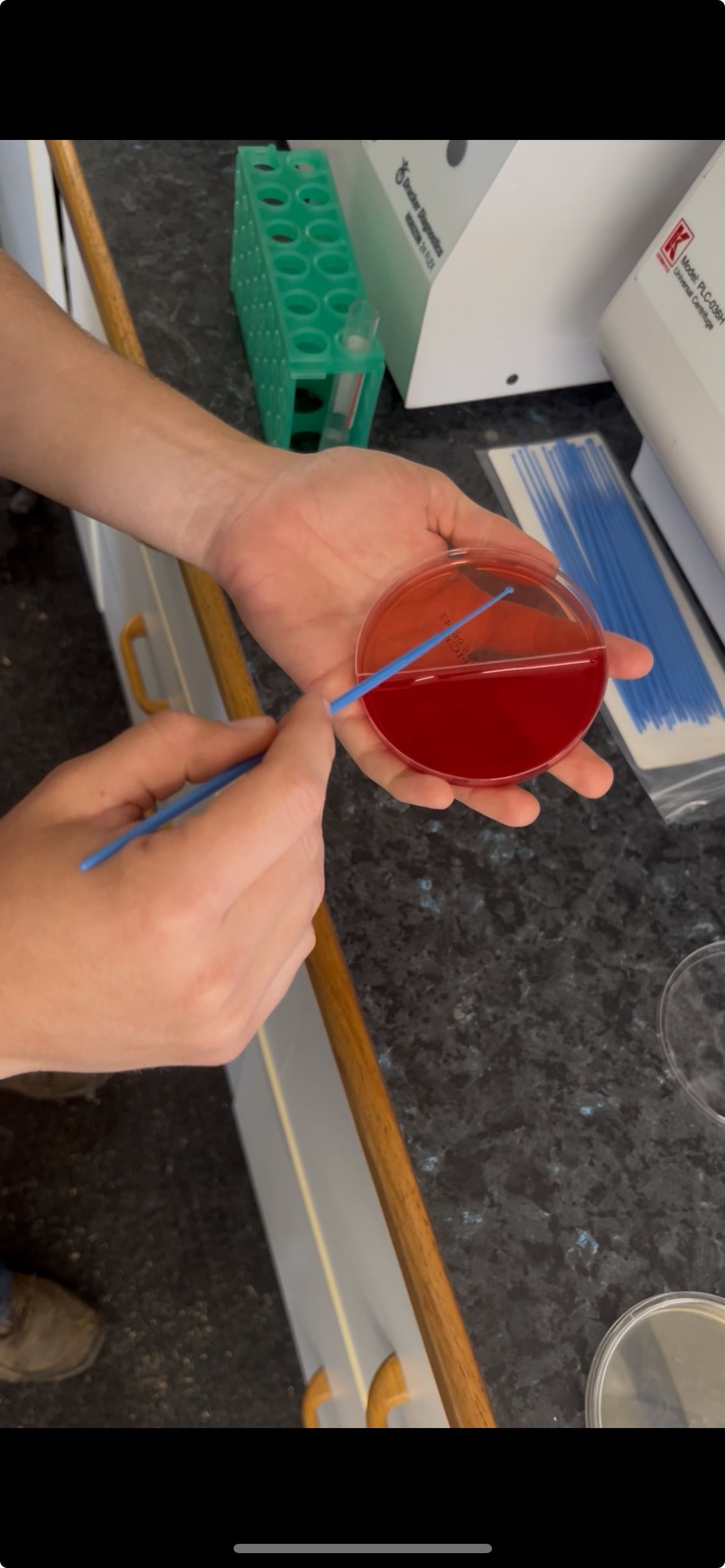
At Maraboon Rural Vet Services, we perform in-house culture and sensitivity testing as part of our equine reproduction service, allowing us to diagnose bacterial infections quickly and accurately. By processing samples in our own laboratory, we can provide faster results, reduce laboratory costs, and make timely treatment decisions during the breeding season.
Why do we perform a uterine culture?
A healthy uterine environment is essential for successful conception and maintenance of pregnancy. Even mares with no obvious clinical signs may have low-grade uterine infections that can reduce fertility.
When infection is suspected, we perform a low-volume uterine lavage (LVL). This technique involves infusing a small volume of sterile fluid into the uterus before recovering the fluid for laboratory analysis. Compared with a traditional swab, LVL samples a larger surface area of the endometrium and has been shown to improve detection of bacterial pathogens.
What happens in our laboratory?
Recovered lavage fluid is cultured on specialised media to identify any bacterial growth. If bacteria are isolated, we perform antimicrobial susceptibility (sensitivity) testing to determine which antibiotics are likely to be effective.
This allows us to select targeted therapy rather than relying on empirical antibiotic use, improving treatment success while supporting responsible antimicrobial stewardship.
Why perform testing in-house?
Many practices send reproductive cultures to external laboratories, which can delay results by several days. Our in-house laboratory allows us to begin processing samples immediately, meaning treatment decisions can often be made sooner, an important advantage when breeding cycles are time-sensitive.
Providing this service also reduces external laboratory costs, making advanced reproductive diagnostics more accessible for our clients.
A specialised diagnostic service
Performing culture and sensitivity testing requires specialised laboratory equipment, strict quality control, and experienced interpretation. It is not a service routinely available at every breeding facility.
Our investment in in-house diagnostics allows us to deliver a higher level of reproductive care and helps maximise breeding efficiency throughout the season.
Beyond reproduction
While uterine cultures are one of the primary applications of our laboratory, the same techniques can also be used to investigate other bacterial infections, including:
-
Synovial (joint) fluid samples
-
Wound and abscess cultures
-
Surgical site infections
-
Other cases where identifying the causative bacteria and the most appropriate antibiotic is essential
Accurate diagnosis leads to targeted treatment, improved outcomes, and more responsible antibiotic use across all areas of veterinary medicine.
Watch our accompanying video for a behind-the-scenes look at how our in-house laboratory processes culture and sensitivity samples, and why this technology is such an important part of modern veterinary care.